
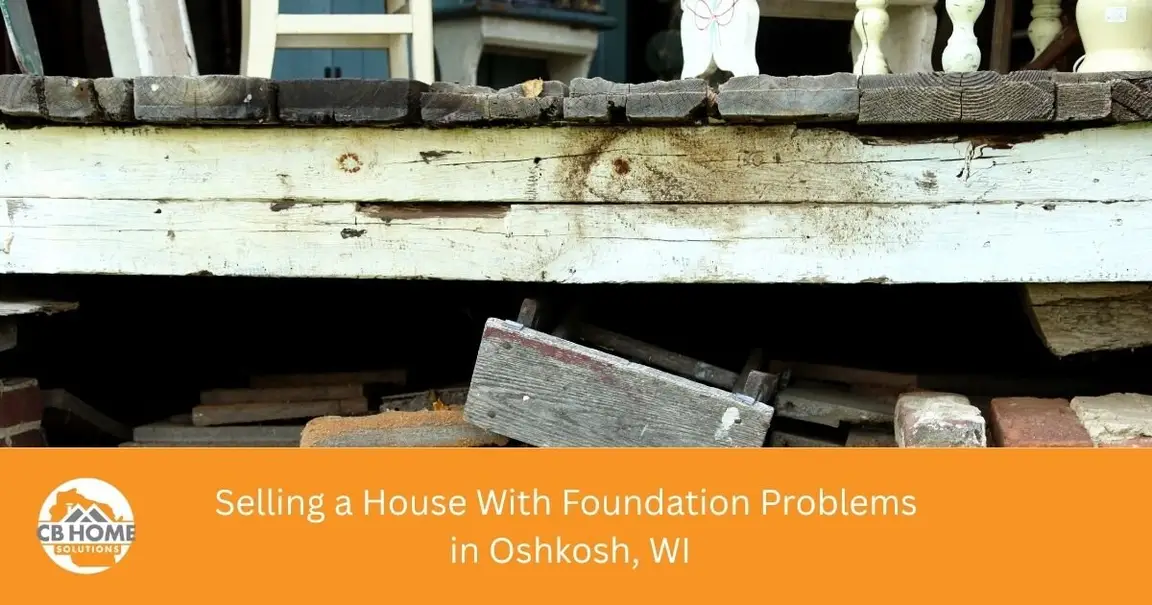
If you own an older home in Oshkosh and you’ve noticed a crack creeping up the basement wall, a door that won’t latch like it used to, or a floor that slopes just enough to roll a marble — you’re not imagining it, and you’re not alone. Foundation movement is one of the most common serious problems we see in Oshkosh homes, and there’s a specific reason for that.
I’m Carter Crowley. My dad Bryan and I have been buying homes in Oshkosh since 2015, and we’ve purchased plenty with foundation issues — from hairline cracks to a house on Michigan Street where the foundation had genuinely caved in. So when someone calls worried that a foundation problem means their home is unsellable, I can tell them the truth: it’s very sellable. But it changes who can buy it and how the sale works, and understanding that is the difference between getting a fair outcome and getting stuck.
Why Oshkosh Has So Many Foundation Problems
This isn’t bad luck — it’s geology.
Oshkosh sits in the Lake Winnebago basin, along the Fox River, on soil that’s heavy with clay. Clay is the single worst soil type for foundations because it’s expansive: it swells when it absorbs water and shrinks when it dries out. Every wet spring and dry summer, the ground under and around your foundation is quietly expanding and contracting, pushing and pulling on the concrete or stone. Over decades, that cycle moves foundations.
Add Wisconsin’s freeze-thaw cycle on top of it. Water in the soil freezes in winter, expands, and heaves; it thaws in spring and settles. That repeated frost movement puts even more stress on foundation walls and footings. Clay-heavy soil in Wisconsin generally requires deeper foundation piers than sandy soil, precisely because the clay moves so much — a detail any local foundation contractor will confirm.
Then there’s the age and construction of the housing stock. Many of Oshkosh’s south-side homes — the neighborhoods around Oregon, Ohio, and Georgia streets — were built in the 1920s through the 1940s, and a lot of them sit on rubble-stone or early block foundations that were never engineered for the soil conditions we now understand. A 90-year-old stone foundation in expansive clay is simply going to move.
So if your Oshkosh home has foundation issues, it’s not because you did anything wrong. It’s the combination of clay soil, freeze-thaw, and an older foundation doing exactly what those conditions produce over time.
The Four Things People Call “Foundation Problems” (and How Serious Each Is)
Not every crack is a crisis. When sellers call me panicked, the first thing I do is figure out which of these they’re actually dealing with, because the severity — and the cost to fix — varies enormously.
1. Hairline and vertical cracks. Thin vertical cracks in a poured wall are extremely common and often not structural — they’re frequently just concrete curing and minor settling. These are usually the cheapest to address, sealed with epoxy or polyurethane injection. Not every crack means five figures of work.
2. Horizontal cracks and bowing/bulging walls. This is the serious one. A horizontal crack or a wall bowing inward is a sign of lateral pressure from saturated soil pushing against the foundation — exactly what expansive clay produces. This indicates structural movement and needs prompt professional evaluation. Left alone, a bowing wall gets worse and can eventually fail.
3. Settling and heave. When one part of the foundation sinks (or heaves upward) faster than another, you get sloping floors, doors and windows that stick, diagonal cracks fanning out from door and window corners, and separation at the sill plate. This “differential settlement” usually means the soil beneath the footing has failed, and the fix involves piers driven down to stable soil.
4. Water intrusion. Chronic basement moisture is both a symptom and a cause — saturated soil drives the pressure that bows walls, and water coming through cracks signals the foundation is no longer sealed. In Oshkosh’s low-lying, high-water-table neighborhoods, this is common and often tangled up with the structural issues.
If you’re not sure which category you’re in, an independent structural engineer’s evaluation (typically a few hundred dollars) is money well spent before you talk to any contractor or make any decision. Never rely only on a repair contractor’s assessment of whether you need their repair.
What Foundation Repair Actually Costs in Oshkosh
Here’s where the honesty matters, because “foundation repair” spans a massive range depending on which of those four problems you have.
Based on current 2026 pricing, in Wisconsin you’re generally looking at:
- Minor crack sealing (epoxy/polyurethane injection): roughly $300–$2,500, depending on how many cracks and their size.
- Bowing-wall stabilization (carbon fiber straps or steel wall anchors): roughly $4,000–$12,000 for a wall, with anchors on the higher end because they can be tightened over time to pull the wall back toward plumb.
- Underpinning/piering for a settling foundation: most homes need several piers; total projects commonly run $10,000–$40,000, with severe differential settlement pushing higher.
- Full foundation replacement: the rare, catastrophic case — $20,000 to $100,000+.
Wisconsin homeowners typically pay somewhere between $4,000 and $12,000 for moderate structural repairs, but the clay-soil factor here matters: expansive clay often requires deeper piers than the national average, which pushes Oshkosh-area costs toward the higher end of any given range. Winter work also runs more because of frozen ground.
The single biggest cost lever is time. A $500 crack sealed today routinely prevents a $15,000 underpinning job later. If you’ve been putting off a small repair, that’s the one worth doing now.
The Real Problem: Foundation Issues and the Financing Wall
Here’s what most sellers don’t realize until a deal collapses: a home with active, visible structural problems usually can’t be sold to a buyer using a mortgage.
FHA, VA, and conventional lenders all require the home to be structurally sound as a condition of financing. When an appraiser or inspector flags a caved-in foundation, a badly bowing wall, or significant differential settlement, the lender won’t fund the loan until it’s repaired. That means the buyer either walks away or demands you fix it before closing — on your dime, on their timeline.
This is exactly what happened with a house we bought on 1711 Michigan St. The owner, Alex, had a foundation that had caved in and a roof that was leaking — significant structural work that would have cost tens of thousands of dollars. As he put it, this wasn’t a house that would qualify for traditional financing; no buyer getting a conventional mortgage could purchase it. His realistic buyer pool had shrunk to cash buyers only.
We evaluated the property, factored in the full scope of the structural repairs, and made him a cash offer based on what the home was worth in its current condition. He accepted, we closed on his timeline, and he walked away with cash and none of the repair headaches. The house is being fully renovated now and will be a solid home for a new family.
We saw the same thing at 1122 Tyler Ave — a shifting foundation and a leaking roof, where the owner had already moved out and just wanted to be done with it. Same solution: a cash offer that accounted for the structural work, and a close on the seller’s schedule.
Your Disclosure Obligation in Wisconsin
One thing you can’t do: hide it. Wisconsin’s Real Estate Condition Report law (Wis. Stat. § 709.03) requires sellers to disclose known defects, and structural or foundation problems squarely qualify. If you know a wall is bowing or the foundation is settling, you must disclose it.
This actually works in your favor when you sell to a cash buyer. We already expect and account for these issues, so there’s no renegotiation surprise at inspection — the condition is priced into the offer from the start. Where sellers get burned is trying to quietly list a home with a known foundation problem, only to have it surface during the buyer’s inspection and blow up the deal weeks in.
Repair vs. Sell As-Is: The Math
So should you fix it or sell as-is? Run the numbers honestly.
Say your Oshkosh home would be worth about $200,000 fully repaired and updated, but it needs $30,000 of foundation work plus a new roof. To sell it on the traditional market, you’d need to front that repair money (or find one of the few buyers willing to take on structural work), wait through the repair timeline — often weeks, sometimes longer with engineering and permits — then list, then wait out the 46-day-average Oshkosh market, then pay 5–6% in commissions.
A cash offer nets you less on paper than a perfectly repaired home would fetch, but you skip the repair bill entirely, skip the financing risk, skip the carrying costs, and close in weeks. For a lot of Oshkosh sellers — especially those who’ve already moved, don’t have $30,000 sitting around for repairs, or just want the problem gone — that trade makes sense.
Whether it makes sense for you depends on your situation, and I’m glad to walk through the actual numbers with you rather than push you one way. Our companion guide on whether to sell your Oshkosh house as-is or make repairs first goes deeper on that decision.
What Amanda Said
Here’s what Amanda Carpenter wrote after selling to us:
“This was my first time selling a house and Carter made it so easy. He came out, took a look, and had an offer to me within the hour. No pressure, no games, just a fair deal. I couldn’t believe how simple the whole thing was.” — Amanda Carpenter, Oshkosh homeowner ⭐⭐⭐⭐⭐
The Bottom Line
Foundation problems are common in Oshkosh because of our clay soil, freeze-thaw cycles, and older housing stock — not because you failed to maintain your home. They range from cheap cosmetic cracks to serious structural movement, and the cost to fix spans from a few hundred dollars to tens of thousands.
The key thing to understand is the financing wall: a home with significant structural issues usually can’t be sold to a mortgage buyer without repairs first, which narrows your realistic options to either fixing it yourself or selling as-is to a cash buyer who accounts for the work.
If you want an honest assessment of where your Oshkosh home falls and what your options are, I’m happy to take a look. You can see how our buying process works, read about how we buy houses as-is across Wisconsin, or review our guide to selling a house with foundation issues. When you’re ready to talk specifics, reach out through our Oshkosh page or call us at (920) 215-4201.
If your foundation issue is on a rental property you’re ready to exit, our guide on selling an Oshkosh rental with tenants in place covers that situation too.
FAQ: Selling a House With Foundation Problems in Oshkosh
Q: Can I sell a house in Oshkosh with a bad foundation? Yes. You can’t hide the problem — Wisconsin law requires you to disclose known structural defects — but you can absolutely sell it. The main change is your buyer pool: most mortgage lenders won’t finance a home with significant structural issues, so your realistic buyers are cash investors who account for the repair cost in their offer.
Q: How can I tell if my foundation problem is serious or cosmetic? As a rough guide: thin vertical cracks are often just settling and relatively minor, while horizontal cracks, inward-bowing walls, sloping floors, and diagonal cracks fanning from door and window corners signal structural movement that needs prompt evaluation. The reliable answer is an independent structural engineer’s assessment, usually a few hundred dollars, before you commit to any repair.
Q: How much does foundation repair cost in the Oshkosh area? It depends entirely on the problem. Minor crack sealing runs a few hundred to a couple thousand dollars. Bowing-wall stabilization runs roughly $4,000–$12,000. Underpinning a settling foundation with piers commonly runs $10,000–$40,000. Because Oshkosh’s clay soil often requires deeper piers, local costs tend toward the higher end of these ranges.
Q: Why do foundation problems scare off buyers in Oshkosh? Because FHA, VA, and conventional loans require a structurally sound home. When an appraiser flags a foundation issue, the lender won’t fund the loan until it’s repaired — so a financed buyer usually can’t close on the home as-is. That’s why homes with real structural problems typically need a cash buyer.
Q: Should I repair the foundation before selling or sell as-is? Run the math. If you have the cash to repair, the time to wait through the work and a normal listing, and the home would fetch significantly more repaired, fixing it may net more. If you’ve already moved, don’t have repair money, or just want it done, selling as-is to a cash buyer skips the repair bill, financing risk, and carrying costs. Neither is automatically right — it depends on your situation.
Q: Do I have to tell buyers about a foundation problem I know about? Yes. Wisconsin’s Real Estate Condition Report law (Wis. Stat. § 709.03) requires disclosure of known defects, including structural and foundation issues. Trying to conceal a known problem risks the deal collapsing at inspection and potential legal liability after closing.