
When Freeman called me, he was dealing with two losses at the same time.
He’d recently lost his mother. Then, a month later, he found her boyfriend of 36 years — a man who had been part of the family for decades — deceased in her home on N 25th Street. On top of the grief, Freeman was now responsible for a house full of belongings, deferred maintenance, and burst pipes in the basement.
“I don’t even know where to start,” he told me.
I hear versions of that sentence more than almost anything else in this business.
Inheriting a house in Milwaukee rarely feels like receiving something. Most of the time it feels like being handed a problem — especially when the property is in rough shape, you don’t live nearby, or you’re still in the middle of grieving.
I’m Carter Crowley. My dad Bryan and I run CB Home Solutions out of Oshkosh, and we’ve been buying properties across Wisconsin since 2015. We’ve purchased dozens of homes across the Milwaukee metro, and inherited properties are one of the most common situations we work through with families. This guide walks you through exactly what to expect — the probate process, your options for the property, and how to decide what makes the most sense for your situation.
What Happens to a House When Someone Dies in Wisconsin
The first thing to sort out is how the house was titled, because that determines almost everything else.
Joint tenancy with right of survivorship: If the deceased co-owned the property with a spouse or another person as joint tenants, ownership passes automatically to the surviving owner — no probate required. You file an Affidavit of Survivorship with the Milwaukee County Register of Deeds, attach a copy of the death certificate, and title is transferred. This is the cleanest scenario.
Transfer-on-death deed: Wisconsin allows homeowners to record a Beneficiary Deed (also called a transfer-on-death deed) that names a beneficiary who receives the property automatically at death. If this is in place, the beneficiary files an Affidavit of Survivorship similarly to above. No probate needed.
Property owned solely in the deceased’s name — with a will: This is the most common scenario for inherited Milwaukee properties. The estate must go through Milwaukee County probate court. The will is submitted, a personal representative (executor) is appointed by the court, and that person is given legal authority to manage and sell the property.
Property owned solely — without a will (intestate): If there’s no will, Wisconsin’s intestacy laws dictate who inherits. For most families that means a surviving spouse or children. The probate court still appoints a personal representative, but it’s the court — not a document — that determines who gets what.
Small estate affidavit: Wisconsin allows a simplified process if the total estate value (not just the house) is under $50,000. This won’t apply to most Milwaukee homes, but it’s worth checking with a probate attorney if the estate is modest.
If you’re not sure how the property was titled, the Milwaukee County Register of Deeds (200 E Wells St) has public records going back decades. You can look up the deed yourself or ask a title company to run a search.
The Milwaukee County Probate Process — What to Expect
For a standard probate in Milwaukee County, here’s a realistic timeline:
Filing and appointment (1–3 months): The will is filed with the Milwaukee County Circuit Court Probate Division. The personal representative is formally appointed. This person now has legal authority to act on behalf of the estate — including selling the house.
Inventory and notice period (3–6 months): An inventory of estate assets is filed. Creditors are given a notice period to submit claims against the estate (typically 4 months in Wisconsin).
Sale and distribution (timeline varies): Once the creditor period has run and the court approves the sale, the personal representative can sign closing documents on behalf of the estate. Final distribution to heirs follows.
Total probate timeline in Wisconsin typically runs 9–18 months for a standard estate. It can move faster with good legal counsel and a cooperative family, and much slower when heirs disagree or creditor claims are contested.
Important: The personal representative can list or sell the property during probate — you don’t have to wait until probate closes. The court may require approval of the sale price depending on the will’s language and the judge’s orders, but experienced Wisconsin probate attorneys navigate this routinely.
Your Three Options for an Inherited Milwaukee Property
Once you have legal authority to sell, you essentially have three paths:
Option 1: Sell As-Is to a Cash Buyer
This is the path most families with older or distressed Milwaukee properties choose — especially if the home needs significant work, is full of belongings, or heirs are out of state and don’t want to manage a renovation from a distance.
What it looks like: A cash buyer walks the property, makes an offer within 24–48 hours, and closes in 14–30 days. No repairs required. No cleanout required (we buy with everything left inside). No agent commissions deducted.
The trade-off: A cash offer is almost always lower than what you’d net from a fully renovated, agent-listed sale. The value exchange is certainty, speed, and zero out-of-pocket work.
Freeman’s situation — burst pipes, hoarding condition, the weight of everything he was going through — is exactly why this option exists. He didn’t need more decisions. He needed someone to take it off his plate.
Option 2: Renovate and List With an Agent
If the property is in decent shape or the renovation cost is manageable, listing on the MLS will typically yield the highest net sale price. Milwaukee’s market is solid — median prices around $225,000, and well-positioned homes in neighborhoods like Bay View, the East Side, or the south side move quickly.
The challenge with Milwaukee’s inherited properties specifically: most are older housing stock (pre-1960), and a thorough renovation on a north or central side bungalow can run $40,000–$80,000+ before it’s market-ready. Add 3–6 months for contractors, 45+ days on market, agent commissions of 5–6%, and closing costs — and the math may not favor renovation as clearly as it seems.
If the property is move-in ready or just needs cosmetics, this path deserves serious consideration. If it needs a gut renovation, run the numbers carefully before committing.
Option 3: Rent It Out
Some heirs hold onto the property and rent it — particularly if the home is in a strong rental market area (near Marquette, UW-Milwaukee, or in a neighborhood with reliable tenant demand). This works if there’s equity, you have management bandwidth, and the heirs agree.
In practice, this is harder than it sounds when multiple heirs are involved and none of them want to be a landlord. It also keeps the estate open longer and delays distributions to heirs.
What We’ve Seen in Milwaukee Specifically
Milwaukee’s inherited property landscape has a few recurring patterns we’ve noticed over years of buying here.
Out-of-state heirs are common. Milwaukee has experienced significant population loss over the past few decades, particularly in the north side neighborhoods. Many families who grew up here no longer live here. When parents or grandparents pass, the heirs are in Atlanta, Chicago, Phoenix — managing a Milwaukee property from afar is genuinely difficult.
Probate and code violations intersect. The City of Milwaukee’s Department of Neighborhood Services (DNS) doesn’t pause because a property is in probate. If the home has open code violations, deferred maintenance that triggers complaints, or overgrown grass that draws a citation, those issues continue to accumulate during the estate process. We’ve bought properties where the estate owed thousands in city assessments by the time we closed.
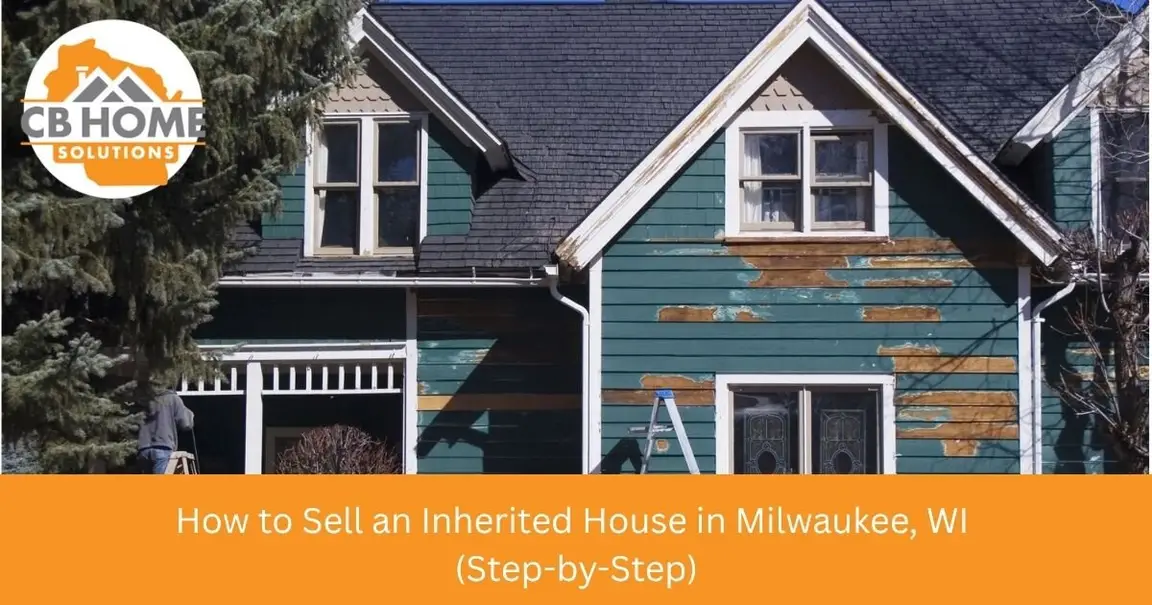
Lead paint is a reality in most of Milwaukee’s inherited homes. The vast majority of properties in Milwaukee were built before 1978. Federal law requires a Lead-Based Paint Disclosure for any pre-1978 home. This is standard for us — it doesn’t kill a deal — but it’s important to understand that most conventional buyers’ lenders will require lead-safe conditions before financing, which means deteriorating paint must be addressed before a traditional sale can close.
Contents are often the emotional sticking point. Every family has a different relationship to the belongings inside an inherited home. Some heirs want to go through everything themselves; others can’t bear to. We’re flexible — we’ll wait while a family takes what they want, and we’ll buy with whatever’s left.
The Capital Gains Question
One thing families frequently ask about: taxes.
When you inherit a house in Wisconsin, you receive what’s called a stepped-up basis — your cost basis is the fair market value of the home on the date of the deceased’s death, not what they originally paid for it. This is significant. If your parent bought a house in Milwaukee in 1975 for $40,000 and it’s now worth $180,000, you don’t owe capital gains on $140,000 of appreciation. Your basis is $180,000.
If you sell the property close to its inherited value, capital gains tax may be minimal or zero. If the market appreciates between the date of death and the date of sale, you owe capital gains on only that increase.
This is worth confirming with a CPA or tax attorney — every estate is different. But the stepped-up basis is one of the significant financial advantages of inheriting rather than receiving a property as a gift during someone’s lifetime.
How Our Process Works When an Estate Is Involved
When a personal representative contacts us about an inherited Milwaukee property, here’s what the process looks like:
Step 1: Walk the property together. I come out, walk through the home, and ask questions. I want to understand the situation — what condition it’s in, what’s still inside, what timeline the estate needs.
Step 2: Make a cash offer. Usually within 24 hours of the walkthrough. I explain exactly how I arrived at the number — what the home is worth, what it costs to bring it to resale condition, and where the offer lands.
Step 3: Confirm the estate has selling authority. We’ll need to confirm the personal representative has Letters Testamentary or Letters of Administration from the Milwaukee County court. Your probate attorney handles this document.
Step 4: Open title and schedule closing. We work with a Wisconsin title company. They run a full title search, identify any liens or outstanding mortgages, and confirm the estate can convey clear title. If there are title issues, we work through them — it’s rare that something can’t be resolved.
Step 5: Close on your timeline. We can close in as few as 14 days or as many as 60 — whatever the estate needs. We’ve closed with mobile notaries for out-of-state personal representatives.
The Bottom Line
Inheriting a house in Milwaukee is a process, not a single decision. The right first step is understanding how the property is titled and whether probate is required. From there, you have options — and the right one depends on the condition of the property, how much time and bandwidth the heirs have, and what the estate ultimately needs financially.
If the home needs significant work, is full of belongings, or you’re managing this from another state, a cash sale is often the most practical path. If it’s in good condition and you have the time and resources to prepare it for market, listing with an agent may yield more money.
We’re happy to walk through either scenario with you — our job isn’t to push a particular outcome, it’s to make sure you understand what your options are.
You can learn more about our process here or read our full guide to selling an inherited home in Wisconsin. If you want to know what we’d offer for the Milwaukee property you’ve inherited, there’s no cost or obligation to find out — reach out through the form on our homepage or call us at (920) 215-4201.
FAQ: Selling an Inherited House in Milwaukee
Q: Do I need to go through probate to sell an inherited Milwaukee house? Not always. If the property was held in joint tenancy, had a transfer-on-death deed, or was in a trust, you may be able to transfer and sell without probate. If it was solely in the deceased’s name, Milwaukee County probate is typically required.
Q: Can I sell the house before probate is finished? Yes. The personal representative can sell the property during probate, not just after it closes. Depending on the will’s language and the court’s orders, the judge may need to approve the sale price, but this is a routine step that Wisconsin probate attorneys handle regularly.
Q: The house is full of belongings and I don’t have the energy to clean it out. What do I do? You don’t have to. We buy houses with everything left inside — furniture, tools, clothing, whatever is there. Take what you want, leave the rest. We handle the cleanout after closing.
Q: What if multiple heirs disagree about whether to sell? This is one of the harder situations. If the personal representative has clear court authority to sell, they can proceed — but a contested sale can lead to litigation among heirs. Most families work it out. When they can’t, the Milwaukee County probate court can order a sale. If you’re in this situation, a Wisconsin probate attorney should be your first call.
Q: The house has city code violations from Milwaukee DNS. Does that affect the sale? Not for a cash sale — we buy regardless of open code violations. For a traditional MLS sale, open violations can complicate financing and may need to be addressed before a lender will fund. The violations will also need to be disclosed to buyers under Wisconsin § 709.03.
Q: How do we handle the mortgage if the property still has one? The mortgage is paid off at closing from the sale proceeds, just like any other sale. If the mortgage balance exceeds the sale price, that’s a more complex situation — talk to a probate attorney and potentially the lender about your options.