
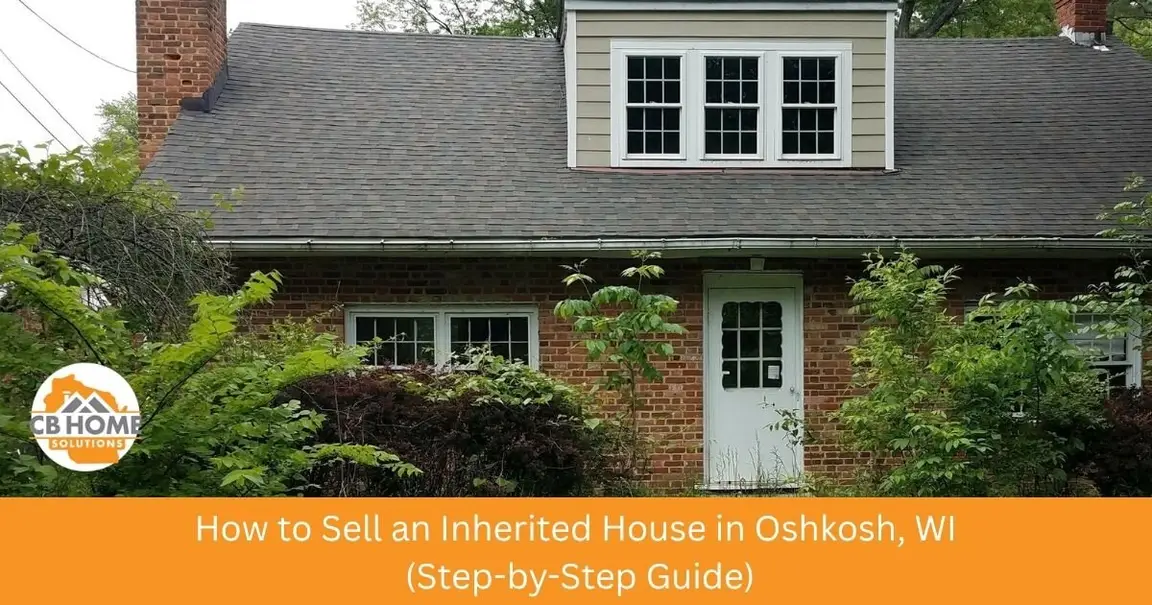
She called me from her car, parked in front of her mother’s house on the north side of Oshkosh.
“I haven’t even been able to go inside yet,” she told me. “Every time I try, I just — I can’t do it.”
Her mom had passed two months earlier. The house was full. Decades of furniture, clothes, collections, paperwork — the way a home looks when someone has lived in it deeply and for a long time. There was no one else to handle it. Her siblings were out of state. She was working full time and grieving, and somewhere in the middle of that she was also supposed to figure out what to do with a house.
I’m Carter Crowley. My dad Bryan and I have been buying homes across Wisconsin since 2015, and we’re based right here in Oshkosh. Inherited properties are one of the situations we work through with families most often — and I’ve learned that the house is almost never the hardest part. The process around it usually is.
This guide covers exactly what you need to know: how title and probate work in Winnebago County, what your realistic options are for the property, and how to decide which path makes the most sense for your situation.
First: How Was the House Titled?
This is the question that determines everything else, and it’s worth figuring out before you do anything else.
Joint tenancy with right of survivorship: If your parent co-owned the home with a spouse or another person as joint tenants, ownership passes automatically to the surviving owner when one person dies. No probate required. The surviving owner files an Affidavit of Survivorship with the Winnebago County Register of Deeds (415 Jackson St, Oshkosh), attaches a certified death certificate, and title transfers. This is the cleanest scenario and it’s common for married couples.
Transfer-on-death deed: Wisconsin allows homeowners to record a Beneficiary Deed naming someone to receive the property at death automatically — similar in effect to a beneficiary on a bank account. If this is in place, the named beneficiary files an Affidavit of Survivorship. No probate needed.
Solely owned — with a will: The most common scenario for inherited Oshkosh properties. The estate goes through Winnebago County Circuit Court probate. The will is submitted, a personal representative (executor) is appointed by the court, and that person receives legal authority to manage and sell the property on behalf of the estate.
Solely owned — without a will (intestate): When there’s no will, Wisconsin’s intestacy statutes determine who inherits — typically a surviving spouse, then children. The court still appoints a personal representative, but it’s state law rather than the deceased’s wishes that governs distribution.
Small estate affidavit: Wisconsin allows a simplified transfer process if the total estate value is under $50,000. Most Oshkosh homes won’t qualify, but if the estate is small it’s worth asking a probate attorney whether this applies.
If you’re unsure how the property was titled, the Winnebago County Register of Deeds has public records you can search, or any Wisconsin title company can run a chain of title search inexpensively.
The Winnebago County Probate Process
For a standard probate — where the home was solely in the deceased’s name — here’s what to expect in Winnebago County:
Filing and appointment (1–3 months): The will is filed with the Winnebago County Circuit Court. The court formally appoints the personal representative and issues Letters Testamentary, which is the legal document that gives that person authority to act on behalf of the estate. This includes signing real estate documents.
Inventory and creditor notice period (3–6 months): Wisconsin law requires an inventory of estate assets and a notice period during which creditors can submit claims against the estate. The creditor claim period is typically four months from the date notice is published.
Sale and distribution (timeline varies): Once the creditor period has run, the personal representative can sell the property and distribute the proceeds to heirs. If the will specifies or the court requires it, the judge may need to approve the sale price — but this is routine in Wisconsin and a competent probate attorney moves through it without delay.
Realistic total timeline for a Winnebago County probate: 9 to 18 months from filing to final distribution, depending on complexity and whether heirs are cooperative. It can move faster with good legal guidance, and considerably slower if the estate is contested.
One thing many families don’t realize: you can sell the house during probate — you don’t have to wait until it closes. Once the personal representative has Letters Testamentary and the court confirms selling authority, you can proceed. Many families sell the property partway through the probate process because holding a vacant house costs money — property taxes, utilities, insurance, and upkeep don’t stop while the estate winds down.
Your Three Options for the Property
Once you have legal authority to act, the decision comes down to three paths.
Option 1: Sell As-Is to a Cash Buyer
The most common path for families dealing with older or distressed Oshkosh properties — especially when the home needs significant work, is full of belongings, or the heirs don’t live locally.
A cash buyer walks the property, makes an offer within 24–48 hours, and closes in 14–30 days. No repairs. No cleanout. No agent commissions deducted from proceeds. You take what you want from the house and leave everything else behind.
We purchased 1018 Arthur Ave in Oshkosh — an inherited property where the upstairs had been gutted to the studs. The heir lived out of state and simply couldn’t manage a renovation from a distance. We made a cash offer, worked around the estate’s timeline, and closed without requiring any work done first. That’s the kind of situation a cash sale is designed for.
The honest trade-off: a cash offer will almost always be lower than the number you’d net from a fully renovated home sold on the MLS. What you’re exchanging is the difference in price for certainty, speed, and no out-of-pocket work or project management.
Option 2: Renovate and List With an Agent
If the property is in decent condition, or the cost to get it market-ready is manageable relative to the value increase, listing on the MLS will typically generate the highest net proceeds. The Oshkosh market is solid — median home values around $222,000–$251,000, and well-prepared homes move in roughly 46 days on average.
The challenge specific to inherited Oshkosh properties: most of the housing stock in this city is from the 1920s through the 1960s. A home that’s been lived in for 40 or 50 years without significant updating often needs $20,000–$60,000 in work before it’s truly list-ready — new HVAC, updated electrical, kitchen and bath renovations, potential foundation attention given Oshkosh’s clay-heavy soils. Add contractor timelines (good tradespeople in the Fox Valley are typically booked 2–4 months out), 46+ days on market, and 5–6% in agent commissions, and the total cost and time to execute this path is higher than it looks on paper.
That said — if the home is in reasonable shape and you have the time and bandwidth to manage the process, this option deserves honest consideration.
Option 3: Hold and Rent
Some heirs keep the property as a rental, particularly if it’s near the UW-Oshkosh campus or in a neighborhood with reliable tenant demand. This can make sense if there’s equity in the home, no urgency to distribute the estate, and at least one heir willing to take on landlord responsibilities.
In practice, this path is harder than it sounds when multiple heirs are involved, none of them want to manage a rental, and the estate needs to be closed. It also delays distributions to everyone involved.
What We See Most Often With Oshkosh Inherited Properties
After purchasing dozens of homes in Oshkosh over the past decade, a few patterns come up consistently with inherited properties.
The deferred maintenance problem. Many of the homes we buy were lived in for 30–50 years by the same owner. The house was loved and cared for in the ways that mattered — but the furnace is original, the electrical panel is undersized for modern use, the roof has a few more years at best. These aren’t cosmetic issues; they’re structural ones that affect financing. Conventional lenders often require repairs before they’ll fund a purchase on properties in this condition, which narrows the buyer pool significantly.
Out-of-state heirs are common — even in Oshkosh. Not everyone who grew up here still lives here. When the heir is in another state, managing contractor bids, repair timelines, showings, and negotiations from 800 miles away is genuinely exhausting. We’ve closed with out-of-state personal representatives entirely by phone, email, and mobile notary. It doesn’t require anyone to fly back to Wisconsin to sign papers.
Contents are the emotional sticking point. There is no right answer for how to handle a lifetime of belongings. Some families want to take everything meaningful before the house closes; others find they can’t face it. We’re flexible on timeline, and we buy with whatever is left in the house — furniture, appliances, tools, clothing, everything. You take what matters and leave the rest.
The stepped-up basis can significantly reduce your tax bill. When you inherit a home in Wisconsin, your cost basis is reset to the fair market value on the date of death — not what the original owner paid decades ago. If your parent bought the house in Oshkosh in 1978 for $55,000 and it’s now worth $200,000, you don’t owe capital gains on that $145,000 of appreciation. Your basis is $200,000 at the time you inherit. If you sell near that value relatively quickly, capital gains exposure may be minimal. This is worth confirming with a CPA — every estate is different — but it’s an important advantage that many families aren’t aware of.
What Sherri Said
Sherri Simmons sold her mother’s house to us after her mom passed away. Here’s what she wrote in her Google review:
“Carter and his team were absolutely incredible when they bought my mom’s house. We were mourning the loss of my mom. Carter came over and treated us with such compassion and care. We didn’t know anything about selling my mom’s house and he walked with us through every step. We would recommend CB Home Solutions to anyone wanting to sell their house quickly and easily.” — Sherri Simmons, Oshkosh homeowner ⭐⭐⭐⭐⭐
I share that not to sell you on using us, but because I think it captures the thing families need most in this situation — someone patient who explains what’s happening at every step, without pressure.
How Our Process Works When an Estate Is Involved
Step 1: Walk the property. I come out, go through the house, and understand what you’re working with — condition, contents, any visible structural issues. I ask questions about the estate and what timeline the family needs.
Step 2: Make a cash offer. Usually within 24 hours. I explain how I arrived at the number — what the home is worth, what it will cost to bring it to resale condition, and where the offer lands. No mystery, no pressure.
Step 3: Confirm selling authority. We need to confirm the personal representative has Letters Testamentary from the Winnebago County Circuit Court. Your probate attorney handles this. If the estate is still in early stages, we can agree on a purchase price now and schedule closing for when authority is in place.
Step 4: Open title and schedule closing. A Wisconsin title company runs a full search, clears any liens, and confirms the estate can convey clean title. If there are title complications — old liens, missing heirs, unpaid property taxes — they’re usually solvable, and we work through them with you.
Step 5: Close on your timeline. We can close in 14 days or 60 days, whatever works. For out-of-state personal representatives, we arrange a mobile notary. You don’t have to travel back to Oshkosh to sign.
The Bottom Line
The most important first step is understanding how the property was titled and whether Winnebago County probate applies. That single question determines the whole timeline.
From there, your three options — sell as-is, renovate and list, or rent — all have legitimate uses depending on the property’s condition, the heirs’ situation, and what the estate needs. There’s no universal right answer, and I’m not going to pretend there is.
If you want an honest read on what we’d offer for an inherited Oshkosh property, there’s no cost or obligation to find out. You can learn more about how our process works or read our full Wisconsin inherited home guide for more on the legal side. When you’re ready to talk through the specifics, reach out through the form on our Oshkosh page or call us at (920) 215-4201.
FAQ: Selling an Inherited House in Oshkosh, WI
Q: Do I need to go through Winnebago County probate to sell an inherited Oshkosh house? Not always. If the property was held in joint tenancy, had a Wisconsin transfer-on-death deed, or was in a trust, you may be able to transfer title and sell without probate. If the home was solely in the deceased’s name, probate through Winnebago County Circuit Court is typically required before the estate can sell.
Q: Can I sell the house before probate is finished? Yes. The personal representative can sell the property once they have Letters Testamentary from the court — you don’t have to wait until probate closes and the estate is fully distributed. Depending on the will’s language, the judge may review the sale price, but Wisconsin probate attorneys handle this as a routine step.
Q: The house is full of belongings and nobody wants to deal with the cleanout. What are the options? A cash sale is often the cleanest answer to this. We buy homes with everything left inside. Heirs take what has meaning to them, and we handle the rest after closing. There is no cleanout requirement, no junk removal bill, and no need to coordinate that piece of the process.
Q: What if the heirs don’t agree on whether to sell? If the personal representative has clear court authority, they can move forward — but contested sales among heirs can end up in Winnebago County court if the disagreement isn’t resolved. This is one of the scenarios where a Wisconsin probate attorney is not optional. Most families work it out before it gets there.
Q: The house has deferred maintenance and probably needs significant work. Does that kill the deal? Not for a cash buyer. It affects the offer amount — the worse the condition, the lower the offer, because we’re pricing in the cost of repairs. But deferred maintenance, dated interiors, failed systems, and structural issues don’t prevent a cash sale from happening. They do prevent most conventional buyers from getting financing, which is part of why cash buyers exist.
Q: How do we handle an existing mortgage on the property? The mortgage is paid off at closing from the sale proceeds, the same as any other sale. If the balance owed exceeds what the home is worth, that’s a more complex situation — a Wisconsin probate attorney and potentially the lender need to be part of that conversation.