
Some houses tell you their story the moment you walk in the door — and not always in a good way. If your Oshkosh home has decades of cigarette smoke soaked into the walls, or a strong pet odor that no amount of cleaning seems to touch, you already know the problem: buyers notice it in the first ten seconds, and it colors everything they think about the house afterward.
I’m Carter Crowley. My dad Bryan and I have bought a lot of these homes in Oshkosh, and I want to be honest and practical with you about what a heavy-odor home means for a sale — why it’s such a stumbling block on the traditional market, what it actually costs to fix, and why selling as-is is often the simplest way out.
Why This Comes Up So Often in Oshkosh
This isn’t a rare problem here, and there’s a reason. Oshkosh has a lot of long-tenure homeowners — people who’ve lived in the same house for thirty, forty, or fifty years. When someone has smoked indoors for decades, the tar and nicotine don’t just linger in the air; they penetrate the drywall, the carpet and padding, the ceilings, the trim, and the ductwork. The same is true of long-term pet odor in older carpeted homes. Time and porous materials are what turn a smell into a structural problem.
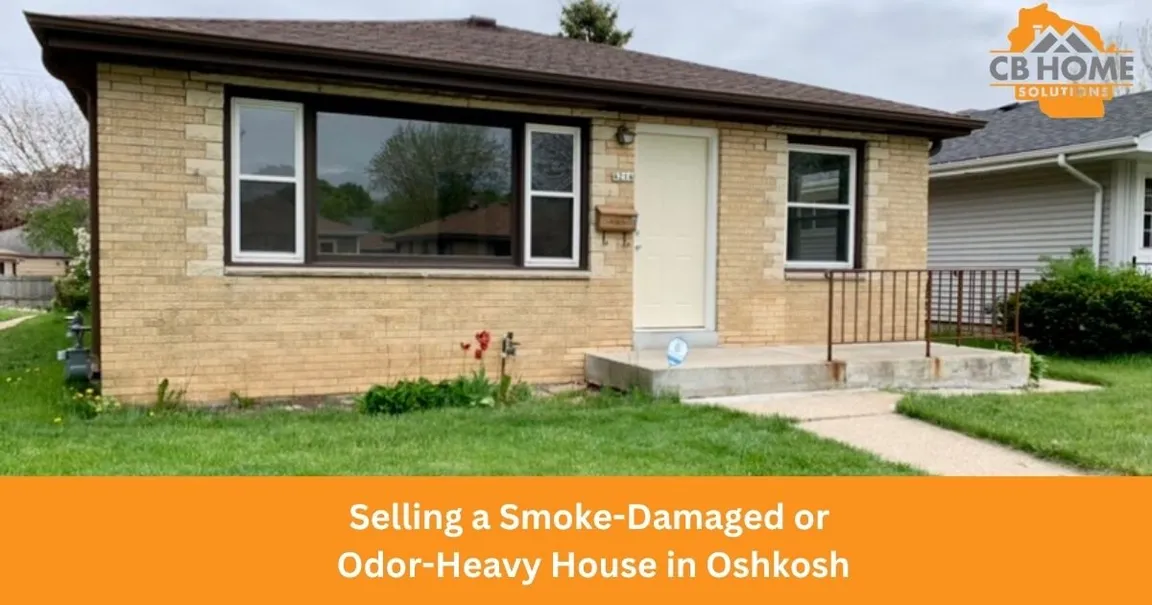
We bought a home on 110 W 17th Ave that’s a textbook example. The owner had been there more than 30 years, and the house had a strong cigarette smell throughout, along with overgrown landscaping and an interior that needed a full remodel. The owner was simply ready to move on — and there was no realistic way to put that house on the traditional market without a major intervention first.
Why Odor Tanks a Traditional Sale
Here’s the uncomfortable truth about selling an odor-heavy home the conventional way: smell is the fastest, most visceral dealbreaker in real estate. A buyer can look past a dated kitchen or ugly carpet because they can picture changing it. But a strong smoke or pet odor triggers a gut reaction — what else is wrong with this house? — and that reaction is very hard to overcome.
It causes concrete problems in a traditional sale:
- Showings go badly. Buyers walk in, react to the smell, and mentally check out before they’ve seen the home’s good points.
- Offers come in low. The buyers who don’t walk away often assume the worst about hidden damage and lowball accordingly.
- Financing can get complicated. If the odor comes with related issues — heavy staining, damaged flooring, or the deferred maintenance that often accompanies these homes — an appraiser can flag the property, and the buyer’s lender may balk.
So even though odor is technically “just a smell,” in a traditional sale it behaves like a serious defect.
What Odor Removal Actually Costs
If you wanted to remediate the odor before selling, here’s what you’d realistically be looking at in 2026. And the key thing to understand up front: surface cleaning does almost nothing once smoke or pet odor has penetrated porous materials. Wiping walls and shampooing carpet won’t fix a decades-deep problem — you have to seal and often replace.
Realistic cost ranges:
- Whole-home cigarette smoke remediation: roughly $2,000–$8,000, and heavier cases go higher.
- Ozone or hydroxyl treatment: about $200–$800 to break down airborne and embedded odor molecules (the space has to be vacant during ozone treatment).
- Sealing and repainting (the step that actually locks in wall odor): roughly $400–$3,000 depending on the size of the home. This is essential — paint alone without a proper primer-sealer just lets the smell bleed back through.
- Carpet and padding replacement: often $785–$2,800+, because odor lives in the padding, not just the carpet.
- Duct and HVAC cleaning: roughly $300–$1,200, since the system has been circulating the smell for years.
- Pet odor remediation: commonly $300–$2,000 depending on how deep it’s soaked into flooring and subfloor.
One more thing worth knowing: homeowners insurance generally covers smoke damage from a fire event, but not odor built up from years of smoking or pets. So this is usually an out-of-pocket cost — and for a full-house job on a long-smoked-in home, it adds up fast, often before you’ve addressed any of the other repairs these homes tend to need.
Why a Cash Buyer Doesn’t Flinch
Here’s why selling as-is works so well for these homes. When we buy a house like 110 W 17th Ave, we’re planning to renovate it anyway — new flooring, fresh drywall or sealed-and-painted walls, updated systems. The odor remediation is simply folded into a renovation we were going to do regardless. What reads as a dealbreaker to a retail buyer is, to us, just another expected line item.
That means:
- No cleaning, sealing, or remediation on your end. You don’t spend a dime chasing the smell out.
- No failed showings. There’s no parade of buyers reacting to the odor, because there are no showings.
- A fair cash offer that accounts for the condition — priced honestly, with the remediation built into our numbers, not held over your head.
You take what matters to you, leave the rest, and we handle the house from there.
The Honest Comparison
As always, I’ll give you the straight version. If your home’s odor is relatively light — a single smoker for a few years, or a pet issue confined to one room — a targeted cleaning, sealing, and carpet replacement might be worth doing before listing, and could open the home up to a traditional buyer at a higher price. In that case, listing may net you more.
But when the odor is decades deep and comes bundled with the other things these homes usually need — dated systems, worn interiors, deferred maintenance — the cost and hassle of getting it market-ready often outweighs the difference in sale price. That’s when selling as-is is the smarter, simpler move.
The Bottom Line
A smoke- or odor-heavy home is one of the harder properties to sell on the traditional market, not because the problem is unfixable, but because remediation is expensive, surface cleaning doesn’t work, and buyers react to smell more strongly than to almost anything else. Selling as-is to a cash buyer who’s renovating anyway removes that entire obstacle — no remediation, no failed showings, no out-of-pocket cost.
If you’d like an honest, no-pressure read on your Oshkosh home — including a fair cash offer that accounts for the condition — I’m glad to help. You can learn how we buy houses as-is in any condition, how we buy fixer-upper houses across Wisconsin, or reach out through our Oshkosh page or call (920) 215-4201.
For related situations, see our guides on whether to sell your Oshkosh house as-is or make repairs first, downsizing and selling the family home in Oshkosh (many long-tenure odor homes are also downsizing moves), and selling a hoarder home in Oshkosh (a related difficult-condition situation).
FAQ: Selling a Smoke- or Odor-Heavy House in Oshkosh
Q: Can I sell a house that smells like cigarette smoke? Yes. You can remediate it first and list it, or sell it as-is to a cash buyer who accounts for the odor in their offer. Because heavy smoke odor is expensive to remove and tends to come with other repair needs, many Oshkosh sellers with long-smoked-in homes find selling as-is is the simpler, more cost-effective route.
Q: Why won’t cleaning get rid of the smoke smell? Because after years of indoor smoking, tar and nicotine penetrate porous materials — drywall, carpet padding, trim, and ductwork. Surface wiping and shampooing barely touch embedded odor. Real removal requires sealing and repainting walls with a proper primer-sealer, replacing carpet and padding, cleaning ducts, and often ozone treatment.
Q: How much does it cost to remove smoke odor from a whole house? In 2026, whole-home cigarette smoke remediation typically runs $2,000–$8,000, with heavier cases higher. That usually includes sealing and repainting ($400–$3,000), carpet and padding replacement ($785–$2,800+), duct cleaning ($300–$1,200), and ozone treatment ($200–$800). Insurance generally doesn’t cover odor from habitual smoking, so it’s an out-of-pocket cost.
Q: Does pet odor hurt my home’s sale the same way? Yes. Like smoke, pet odor soaks into carpet, padding, and subfloor and produces the same strong buyer reaction. Remediation commonly runs $300–$2,000 depending on how deep it’s penetrated. A cash buyer who’s replacing flooring anyway isn’t deterred by it.
Q: Do I have to disclose smoke or pet odor to a buyer? Wisconsin’s Real Estate Condition Report law (§ 709.03) requires disclosure of known defects. Significant odor issues, and any related damage, should be disclosed. Selling as-is to a cash buyer sidesteps the renegotiation risk, because the condition is already priced into the offer up front.
Q: My home just has a mild smell in one room. Should I still sell as-is? Maybe not. If the odor is light and localized, a targeted cleaning, sealing, and carpet replacement may be worth doing before listing, and could net you more on the traditional market. As-is is the better route when the odor is deep, whole-house, and bundled with other repair needs.