
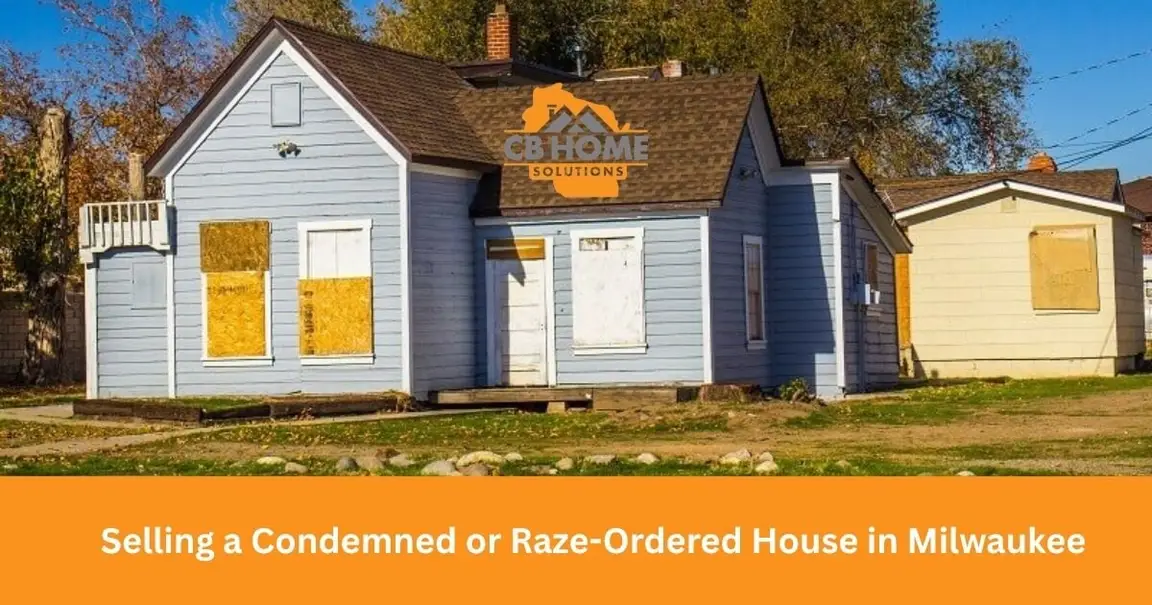
If the City of Milwaukee has condemned your property, or you’ve received a raze order from the Department of Neighborhood Services, you’re holding a piece of paper with a deadline on it — and that changes everything about your situation. It feels like the city has taken the decision out of your hands. It hasn’t, not entirely. You still have options, and one of the most important is that you can still sell the property, even in this condition.
I’m Carter Crowley. My dad Bryan and I run CB Home Solutions, and we’ve bought distressed and condemned properties across Milwaukee, including homes the city had flagged. This guide explains what condemnation and raze orders actually mean in Milwaukee, how the city’s clock works, and how to sell a condemned property before the situation gets worse.
What “Condemned” Actually Means in Milwaukee
“Condemned” gets used loosely, so let me be precise about what the City of Milwaukee’s process actually involves, because the details determine your options and your timeline.
Milwaukee’s Department of Neighborhood Services (DNS) enforces the building code. When a property has serious problems, DNS can take escalating actions:
- Orders to correct / repair orders. The inspector issues an order listing violations with a compliance deadline — serious safety items in as little as 24 hours, most within 30 days.
- Condemnation / placarding. If a building is unfit for occupancy, DNS can condemn it and post a placard, meaning no one may legally live there until the violations are fixed.
- Raze orders. This is the most serious. Under Wisconsin state law (Wis. Stat. § 66.0413), if the cost to repair a building exceeds 50% of its assessed value, the city can order the owner to raze — demolish — the structure.
That 50% threshold is the key one to understand. It’s not about whether the house can be saved in some abstract sense; it’s about whether the repair cost crosses half the assessed value. For much of Milwaukee’s older, lower-valued housing stock, a home that’s fallen into serious disrepair can cross that line more easily than owners expect.
The City’s Clock — and What Happens If You Do Nothing
Here’s the part that makes this urgent. If you receive a raze order and don’t comply, the city doesn’t just wait indefinitely. Milwaukee can hire a private demolition contractor to raze the building itself — and then bill you for it.
And the way they bill you matters. Under Wisconsin law, the cost of the demolition — including preliminary costs like the title search, serving the order, and publication, plus the actual teardown and site restoration — can be charged against the real estate as a lien and collected as a special charge on your property tax bill. In other words, the city tears down your building and attaches the cost to the property. (These special charges are part of the broader family of city liens that can cloud a Milwaukee property’s title — a subject worth understanding in full if you’re dealing with city debt on your home.)
There are real legal safeguards built into this — because demolishing someone’s building is a serious action, the process typically takes six months to a year when an owner doesn’t cooperate, and you have the right to appeal a raze order to the circuit court within the time the statute allows, asking a judge to determine whether the order is reasonable. But make no mistake: if you ignore it, the likely endpoint is a demolished building and a bill attached to your land.
Doing nothing is the one path that reliably ends badly.
Can You Sell a Condemned Milwaukee House? Yes.
Here’s the good news that a lot of owners in this situation don’t realize: you can sell a condemned or raze-ordered property. Condemnation doesn’t strip your ownership — you still hold title, and you can still transfer it.
What changes is who can buy it. A condemned property is off the table for essentially every traditional buyer:
- Owner-occupants can’t buy it — they can’t get a mortgage on a property that’s placarded as unfit for occupancy, and they can’t live in it.
- Financed buyers of any kind are out — no lender will fund a home that fails to meet basic habitability, let alone one under a raze order.
That leaves one realistic buyer pool: cash investors who buy distressed property as a business and can evaluate whether the structure is worth saving or is a teardown. That’s exactly the kind of buyer we are.
What We Evaluate on a Condemned Property
When I look at a condemned or raze-ordered Milwaukee property, I’m weighing a few specific things:
Structure vs. teardown. Is there a viable path to rehabbing the building back to code, or is the realistic outcome a demolition and a new use for the land? Milwaukee’s older housing stock sometimes hides good bones under serious neglect — and sometimes it genuinely is a teardown.
The city’s deadline. How much time is on the raze order or compliance order? That deadline shapes how fast we need to move and whether we’re buying to rehab or to comply with the demolition ourselves.
The debt already attached. Are there existing special-assessment charges, back taxes, or other liens on the property? These get sorted at closing through the title company, but they factor into the numbers.
Because we deal with the city’s processes regularly, taking on a property with an active order isn’t a dealbreaker for us the way it is for a retail buyer. We can move quickly enough to matter when a deadline is bearing down.
The Out-of-State-Heir Version
One scenario we see often: someone inherits a Milwaukee property from a distance, and by the time the estate is sorted, the house has deteriorated — or was already condemned — and city orders are stacking up. Managing a condemned Milwaukee property from another state, while also dealing with probate, is genuinely overwhelming. If that’s your situation, our guide on selling a parent’s Milwaukee home from out of state walks through the probate-and-distance side, and a fast cash sale is often the cleanest way to resolve a condemned inherited property before the city acts.
The Bottom Line
A condemnation or raze order feels like the end of your options, but it isn’t. You still own the property, you can still sell it, and selling to a cash buyer who handles distressed Milwaukee properties is often the smartest move — it resolves the situation before the city demolishes the building and bills you for it. The worst outcome is almost always inaction, because that’s the path that ends in a city demolition, a special-charge lien on your land, and no proceeds to you.
If you’ve got a condemned or raze-ordered Milwaukee property and want to know what we could offer and how fast we could close against your deadline, there’s no cost or obligation to find out. You can learn how we buy houses as-is in any condition, read about the common causes of house condemnation, or reach out through our Milwaukee page or call (920) 215-4201.
For related situations, see our guides on selling an inherited Milwaukee house (condemned inherited properties), selling a Milwaukee rental with tenants in place (a condemned former rental), and what happens to tenants when a property is condemned.
This article is general information, not legal advice. Condemnation and raze orders are governed by specific Wisconsin statutes and Milwaukee ordinances and carry firm deadlines and appeal rights. Consult a Wisconsin real estate attorney about your specific situation and act before your deadline passes.
FAQ: Selling a Condemned or Raze-Ordered House in Milwaukee
Q: Can I sell a condemned house in Milwaukee? Yes. Condemnation doesn’t take away your ownership — you still hold title and can sell the property. What changes is your buyer pool: owner-occupants and financed buyers can’t purchase a condemned home, so the realistic buyer is a cash investor who handles distressed property and can evaluate whether the structure is worth rehabbing or is a teardown.
Q: What is a raze order in Milwaukee? A raze order is the city’s directive to demolish a building. Under Wisconsin law (§ 66.0413), Milwaukee can issue one when the cost to repair a structure exceeds 50% of its assessed value. If the owner doesn’t comply, the city can hire a contractor to demolish it and charge the cost back to the property as a special charge on the tax bill.
Q: What happens if I ignore a raze order? The city can raze the building itself and attach the full cost — including title search, service, publication, demolition, and site restoration — to your real estate as a lien collected as a special charge on your property taxes. You end up with no building, no sale proceeds, and a bill against your land. Inaction is the worst outcome.
Q: How long do I have before the city demolishes my building? It varies, but because demolishing a building is a serious action with legal safeguards, the process typically takes six months to a year when an owner doesn’t cooperate. Your specific deadline is on the order itself. You also have the right to appeal a raze order to the circuit court within the statutory window, asking a judge whether the order is reasonable.
Q: The condemned house has back taxes and city charges on it too. Can I still sell? Yes. Existing special-assessment charges, back taxes, and other liens are sorted at closing through the title company, which clears the title so the property can transfer. A cash buyer experienced with distressed Milwaukee properties expects these and works through them as part of the purchase.
Q: How fast can a cash buyer close on a condemned property? Often within a couple of weeks — fast enough to matter when a city deadline is approaching. Because we deal with DNS processes regularly and don’t rely on financing, an active order isn’t a dealbreaker for us the way it is for a retail buyer. The sooner you reach out relative to your deadline, the more options you’ll have.