
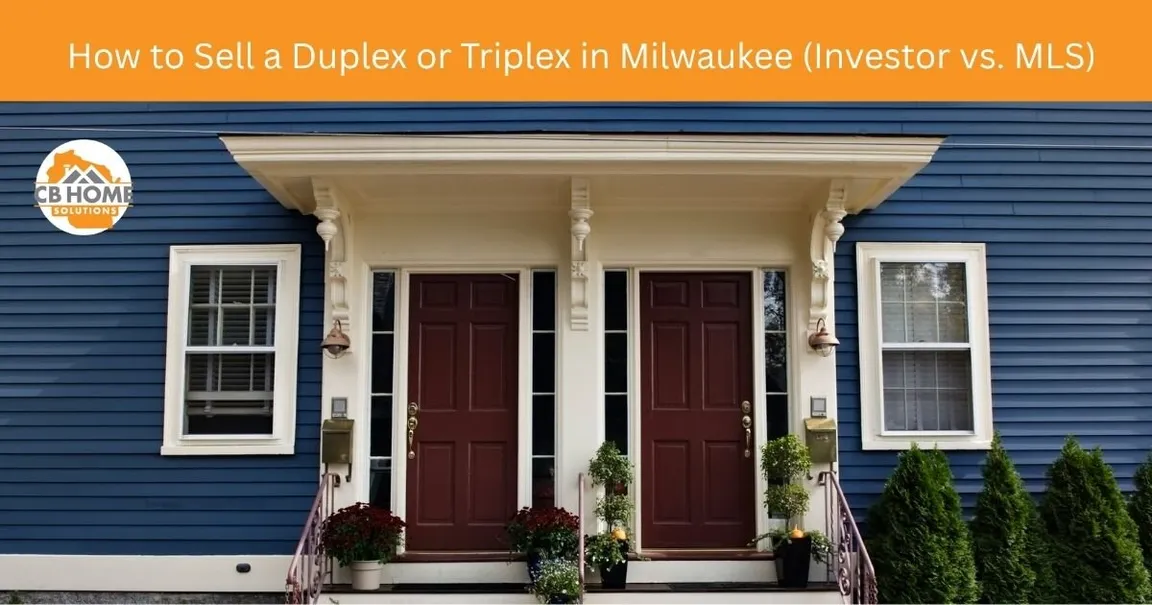
Here’s a fact most Milwaukee homeowners know instinctively but few realize is actually record-setting: Milwaukee has more duplexes, per capita, than any other city in the United States. Roughly 22% of the city’s housing stock is duplexes — more than double Minneapolis and about six times Atlanta. If you own a two- or three-family building here, you own a piece of what makes Milwaukee architecturally unique.
That’s the good news. The complicated news is that selling a duplex or triplex is genuinely different from selling a single-family house — different buyers, different valuation, different rules when tenants are involved. Getting those differences right is the difference between a smooth sale and a listing that sits for months.
I’m Carter Crowley. My dad Bryan and I run CB Home Solutions, and multi-family properties are a core part of what we buy in Milwaukee — including an entire 11-property portfolio we purchased from one out-of-state landlord. This guide walks through how to sell a Milwaukee duplex or triplex, whether you’re better off with an investor or the MLS, and what actually determines what your building is worth.
Why Milwaukee Is a Duplex City
The story goes back to the 1890s. As waves of Polish and German immigrants settled Milwaukee’s south side and Riverwest to work in the factories, tanneries, and mills, they needed affordable housing — and they invented a clever solution. Families would take a simple four-room workers’ cottage, raise it up on jacks, and build a masonry half-basement unit underneath. A single-family home became a duplex practically overnight, and the rental income from the lower unit helped pay the mortgage.
These became known as “Polish flats” (or, to the building inspectors, “English basement duplexes”), and they were built by the thousands. Alongside them came purpose-built two- and three-story duplexes — the front-gabled Queen Anne two-families you still see all over the south side and near north side. By 1920, this housing form had made Milwaukee one of the most densely populated cities in the country.
That history is why, today, Milwaukee is full of small landlords and owner-occupants sitting on duplexes and triplexes. And it’s why, when it’s time to sell, so many of them find the process more complicated than they expected.
Who Actually Buys a Milwaukee Duplex?
The first thing to understand is that your buyer pool for a multi-family property is different — and usually smaller — than for a single-family home. There are three main types:
Owner-occupant “house-hackers.” These are buyers who plan to live in one unit and rent out the other(s) to offset their mortgage. This is one of the most popular ways for first-time buyers to get into the Milwaukee market, and it’s a real source of demand — but only for duplexes in good, move-in-ready condition, and only when at least one unit can be delivered vacant so they can move in.
Small investors. Local buyers looking to add one or two rental doors to their holdings. They care about condition, current rents, and whether the numbers work. They may use conventional investment financing, which comes with its own appraisal and rent-roll requirements.
Portfolio buyers. Companies and experienced investors (like us) who buy multi-family properties as an ongoing business. This group is the most flexible on condition, tenant situations, and deferred maintenance — and often the only realistic buyer when a building has problems that block financing.
Which buyer is right for you depends heavily on your building’s condition and whether it’s occupied — which brings us to valuation.
How a Milwaukee Duplex Is Actually Valued
This is where selling multi-family gets genuinely different from selling a house. There are two ways to value a duplex or triplex, and which one applies depends on the property and the buyer:
The comparable-sales approach. For smaller two-family buildings, especially those an owner-occupant might buy, value is often based on comparable sales — what similar duplexes in the neighborhood have recently sold for, much like single-family valuation. This tends to dominate at the lower end and in owner-occupant-friendly areas.
The income approach. For triplexes and investment-grade multi-family, value is driven by the income the building produces. Investors look at the rent roll, subtract operating expenses to get net operating income (NOI), and apply a capitalization rate (“cap rate”) to estimate value. In simple terms: a building that reliably produces more net income is worth more to an investor, and the cap rate is the lens they use to price that income stream.
Here’s the practical implication for you as a seller: if your building’s rents are below market, or units are vacant, or the condition is dragging down what it could rent for, an income-based buyer will value it lower. Some sellers raise rents to market or fill vacancies before selling to improve the income picture — but that takes time, and Wisconsin tenant law governs how and when you can change rents on existing tenants.
The Occupied-Units Problem
The single biggest complication in selling a Milwaukee duplex is tenants. If both units of your duplex are occupied — especially with tenants on active leases — most owner-occupant buyers can’t purchase it, because they need a unit to move into. And if a tenant is on a fixed lease, that lease transfers to the new owner; you can’t simply remove them to deliver a vacant unit.
This is such an important topic that I’ve covered it in depth in a separate guide on selling a Milwaukee rental property with tenants in place — including the Wisconsin notice rules, what happens to leases and security deposits at closing, and Milwaukee’s Tenant Right of First Refusal ordinance. If your duplex is occupied, read that alongside this one, because the tenant situation will shape your entire strategy.
The short version: an occupied duplex sells to investors and portfolio buyers, not owner-occupants. A duplex you can deliver vacant (or half-vacant) opens up the house-hacker market and often a higher price — but getting there legally takes time and can’t always be done.
Selling Occupied vs. Delivering Vacant
So should you deliver the building vacant or sell it occupied? The honest trade-offs:
Deliver vacant (or partially vacant) when: the building is in good condition, at least one tenant is month-to-month and genuinely ready to move, and you have time to coordinate. This opens the property to owner-occupant house-hackers, who often pay the most for a well-kept duplex in a desirable area.
Sell occupied when: tenants are on fixed leases you can’t terminate, a tenant is non-paying and you’d face a lengthy eviction, the building needs significant work regardless, or you simply want it done without managing vacancies and showings around tenants’ schedules. Occupied buildings sell to investors and portfolio buyers who don’t need to move in.
There’s rarely a universally “right” answer — it depends on your building, your tenants, your timeline, and how much complexity you want to manage.
What a Portfolio Sale Looks Like: The Trevor Story
The clearest example I can give you of the occupied-multi-family path is Trevor. He owned eleven Milwaukee-area rental properties from out of state — a mix of duplexes and single-family rentals on Sherman Blvd, Rohr Ave, Custer Ave, Lawn Ave, Linwal Ln, and several north-side addresses. His property management company wasn’t performing, some units had issues, and managing eleven buildings from another state had become a second job he didn’t want.
Selling those eleven properties one at a time on the MLS would have been a logistical nightmare — coordinating showings around tenants across eleven buildings, dealing with financing contingencies on each, and carrying all of them for months while they sold piecemeal. Instead, he sold the entire portfolio to us in one transaction, with tenants in place, as-is. One buyer, one closing, one clean exit.
Not everyone selling a duplex has eleven of them — but the same logic applies to a single occupied two-family. When condition or tenants narrow your buyer pool, an investor sale trades some top-line price for speed, certainty, and the elimination of the whole occupied-listing headache.
Investor vs. MLS: How to Decide
Here’s the honest framework:
List on the MLS when your duplex is in good, move-in-ready condition, you can deliver at least one unit vacant, and you have time to wait for the right owner-occupant or investor buyer. In a desirable area with a clean building, this usually nets the most money.
Sell to an investor/cash buyer when the building is occupied with fixed leases, needs significant repairs, has code or financing problems, or you need speed and certainty over squeezing out the last dollar. This is also the path when you’re exiting multiple properties at once.
I’ll give you a straight answer for your specific building if you ask — including telling you to list it if that’s genuinely your best move.
The Bottom Line
Selling a duplex or triplex in Milwaukee isn’t like selling a single-family house. Your buyer pool is narrower, valuation may hinge on income rather than just comps, and if the building is occupied, Wisconsin tenant law shapes everything. The right path — investor or MLS — depends on your building’s condition, whether you can deliver it vacant, and how much time and complexity you’re willing to take on.
If you’d like to know what we’d offer for your Milwaukee duplex, triplex, or small multi-family — occupied or not, any condition — there’s no cost or obligation to find out. You can learn how we buy rental properties with tenants in place or read more about our company. When you’re ready, reach out through our Milwaukee page or call (920) 215-4201.
For related situations, see our guides on selling a Milwaukee rental with tenants in place, selling a house in foreclosure in Milwaukee (relevant for distressed multi-family), and selling a house with lead paint in Milwaukee (common in older duplexes).
FAQ: Selling a Duplex or Triplex in Milwaukee
Q: Can I sell my Milwaukee duplex with tenants living in both units? Yes, but it narrows your buyer pool. Owner-occupant buyers usually need a vacant unit to move into, so a fully occupied duplex typically sells to investors or portfolio buyers. Any existing leases transfer to the new owner at closing. See our dedicated guide on selling a Milwaukee rental with tenants in place for the full tenant-law details.
Q: How is a duplex valued differently from a single-family home? Two ways. Smaller two-family buildings are often valued on comparable sales, like houses. Triplexes and investment-grade multi-family are typically valued on the income they produce — investors calculate net operating income and apply a cap rate. If your rents are below market or units are vacant, an income-based buyer will value the building lower.
Q: What’s a cap rate, and why do investors care about it? A capitalization rate is a way investors estimate a property’s value based on the income it generates — essentially the annual net operating income divided by the price. It lets an investor compare income properties. A building that reliably produces more net income at a given price is more attractive. It’s the main lens investors use to price a Milwaukee multi-family.
Q: Should I raise rents or fill vacancies before selling my duplex? It can raise the value for an income-based buyer, but it takes time, and Wisconsin law governs how and when you can change rents on existing tenants. Whether it’s worth it depends on how far below market your rents are and how quickly you need to sell. For a quick as-is sale, it usually isn’t necessary — a cash buyer prices in the current situation.
Q: Is it better to sell my Milwaukee duplex to an investor or list it on the MLS? List on the MLS if the building is in good shape, you can deliver a unit vacant, and you have time — that usually nets the most. Sell to an investor if it’s occupied with fixed leases, needs significant work, has financing-blocking issues, or you need speed and certainty. The right answer depends on your specific building and situation.
Q: Can you buy multiple rental properties from me at once? Yes. We’ve purchased entire portfolios in a single transaction — including an 11-property Milwaukee-area portfolio from one out-of-state landlord, with tenants in place and as-is. Selling multiple buildings to one buyer avoids coordinating separate listings, showings, and closings across all of them.