
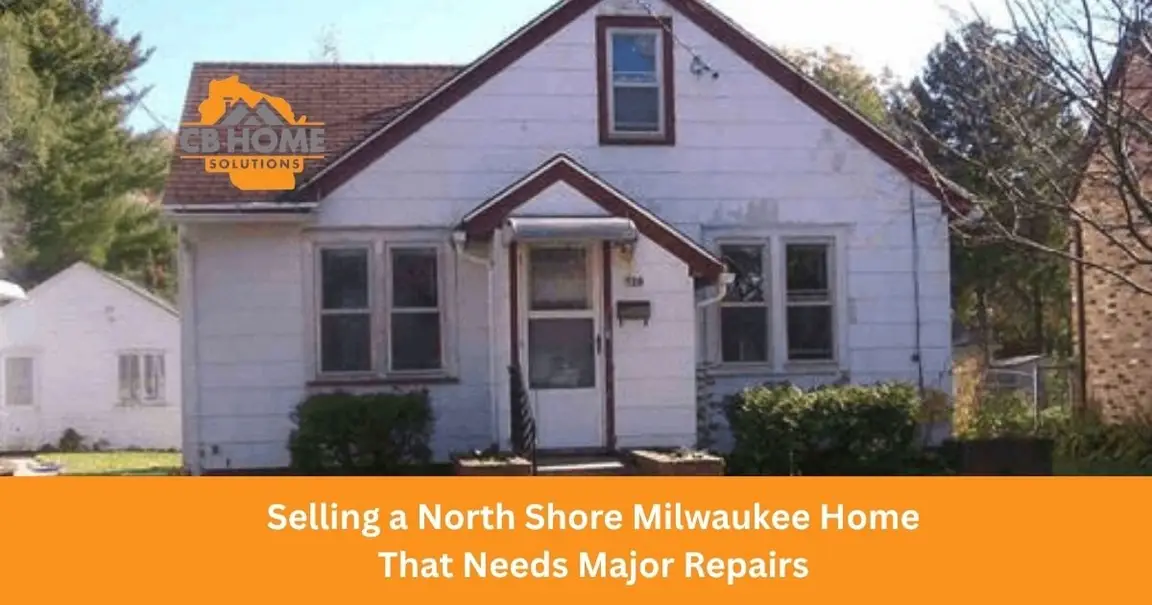
There’s a particular situation on Milwaukee’s North Shore that surprises the people living through it: you own a home in Whitefish Bay, Shorewood, or Fox Point — a desirable, high-value neighborhood where houses sell for well over half a million dollars — and yet the repair estimate you’re staring at has six figures on it. How can a home worth that much need that much work? The answer lies in the age of the housing stock, and it changes how you should think about selling.
I’m Carter Crowley. My dad Bryan and I run CB Home Solutions, and we buy homes across the Milwaukee metro, including the North Shore. This guide is for owners of higher-value Milwaukee-area homes facing a major repair bill — where the numbers are big on both sides — and trying to decide whether to fix, list, or sell as-is.
Why a $550,000 Home Can Need $150,000 of Work
The North Shore is defined by its beautiful, established housing. Whitefish Bay’s median has been running in the low-to-mid $500,000s, with Fox Point and Shorewood in the mid-$400,000s and homes near the lake climbing well past $1 million. These are among the most desirable addresses in metro Milwaukee.
But here’s the thing about that housing stock: it’s old. The North Shore is full of pre-war and century-old homes — Tudors, Colonials, and grand bungalows built in the 1910s, ’20s, and ’30s. That architecture is exactly why people love these neighborhoods. It’s also why the repair bills can be enormous.
When a home has stood for 90 or 100 years, entire building systems reach the end of their life more or less at once:
- Knob-and-tube or aging electrical that needs a full rewire to modern standards.
- Original or mid-century plumbing — galvanized supply lines, aging cast-iron drains — due for replacement.
- Boilers and radiator heat that are original or near it.
- Slate or tile roofs that are gorgeous and staggeringly expensive to properly repair or replace.
- Foundations and basements in century-old homes with water and structural issues.
- Plaster, lead paint, asbestos, and old windows — the hidden costs of pre-1978 (indeed pre-1940) construction.
Any one of these is expensive. When several come due together in a large, older North Shore home, the total repair scope can genuinely reach into six figures. This isn’t hypothetical — it’s common enough across Milwaukee’s older housing that even homes in strong neighborhoods routinely carry very large “scope of work” estimates when they change hands in as-is condition.
The Trap: High-Value Neighborhood, High-Cost Repairs
Here’s why this situation is genuinely tricky, and different from selling a distressed home in a lower-value neighborhood.
In a lower-value area, the calculation is often simple: the repair cost exceeds what the neighborhood comps will ever support, so you sell as-is. On the North Shore, the comps are high — a beautifully restored home really can sell for $600,000, $700,000, or more. That means, in theory, the repairs could “pay off.” But that theory comes with heavy conditions:
- You need the capital. A six-figure renovation means having six figures to spend, or the ability to borrow it, before you see any return.
- You need to manage a major project. A gut renovation of a century-old home is months of contractors, permits, surprises behind the walls, and cost overruns — the kind of project where the final bill routinely exceeds the estimate.
- You need to carry the home the whole time. Property taxes on a North Shore home are substantial, and you’re paying them (plus insurance and utilities) through every month of the renovation and the subsequent listing.
- You take on the risk. If the renovation runs over — and old-home renovations frequently do — that overage comes straight out of your eventual profit.
For some owners with the capital, appetite, and time, restoring a grand old North Shore home to command a top-of-market price is worth it. For many others — an estate settling a parent’s longtime home, an owner who’s aged in place and can’t manage a renovation, someone who’s inherited a beautiful but neglected property from out of state — that path simply isn’t realistic.
When Selling As-Is Makes Sense on the North Shore
Selling as-is to a cash buyer is the right move on the North Shore in specific situations:
An estate or inherited home. Heirs settling a parent’s longtime North Shore home often don’t have the capital or the desire to pour six figures into a renovation, especially from out of state. (Our guide on selling a parent’s Milwaukee home from out of state covers this.)
An owner who can’t manage the project. Aging owners, health situations, or anyone without the bandwidth for a months-long gut renovation.
A home where the numbers are too uncertain. When the repair scope is so large that the risk of cost overruns eats the potential upside, certainty can be worth more than a theoretical higher sale price.
You simply don’t want to. That’s a legitimate reason. Not everyone wants to become a general contractor on a century-old house.
In these cases, we buy the home as-is — taking on the six-figure renovation, the risk, and the management — and you skip all of it. You get a fair cash price that accounts for the real repair scope, and you close on your timeline.
The Honest Comparison — Which Matters More Here
I want to be especially straight on the North Shore, because the stakes are high enough that a wrong decision costs real money.
If your North Shore home needs major work, but you have the capital, the appetite for a big project, and time, and the neighborhood comps clearly support a strong after-renovation price — then renovating and listing (or even listing as-is to a retail buyer or another investor, given how desirable these neighborhoods are) may well net you more than my cash offer. In a strong North Shore location, there’s often a market of buyers and investors willing to take on a project themselves. I’ll tell you honestly when that’s your situation, because on a high-value home the difference can be substantial.
Where my offer earns its place is when you can’t or don’t want to fund and manage a six-figure renovation, when an estate or life situation makes speed and simplicity paramount, or when the repair scope is uncertain enough that you’d rather have a sure number than roll the dice on a renovation. On the North Shore, the decision is less “can I sell?” and more “do I want to take on this project, or hand it off?” — and both answers are legitimate.
The Bottom Line
On Milwaukee’s North Shore, a high home value and a high repair bill can coexist, because the same century-old architecture that makes these neighborhoods desirable also means entire building systems come due at once. That creates a genuine decision: the comps may support a renovation, but only if you have the capital, the appetite, and the tolerance for risk to see a six-figure project through. When you don’t — an estate, a life change, an out-of-state heir, or simply no desire to run a gut renovation — selling as-is hands off the whole project and gives you a certain number.
If you’d like an honest read on your North Shore home — including a candid “you’d likely net more restoring and listing this one” when that’s true — I’m glad to help. You can learn how we buy houses as-is in any condition, how we buy fixer-upper houses across Wisconsin, or reach out through our Milwaukee page or call (920) 215-4201.
For related reading, see our guides on selling a duplex or triplex in Milwaukee (older multi-family with big repair needs), whether to sell as-is or fix your Milwaukee home for an FHA buyer (the repair-decision framework), and what it really costs to sell a house in Milwaukee (running the full net numbers).
FAQ: Selling a North Shore Milwaukee Home That Needs Major Repairs
Q: How can a high-value North Shore home need six-figure repairs? Because the North Shore’s desirable housing stock is old — many homes are pre-war or century-old Tudors, Colonials, and bungalows. When a home has stood 90–100 years, major systems (electrical, plumbing, roof, boiler, foundation) reach the end of their life around the same time. Several big-ticket repairs coming due together can push the total scope into six figures even on a beautiful home.
Q: Should I renovate my North Shore home before selling, or sell as-is? It depends on three things: whether you have the capital for a six-figure renovation, whether you want to manage a months-long project, and your tolerance for cost-overrun risk. Because North Shore comps are high, renovating can pay off if you have all three. If you don’t — an estate, a life change, or simply no desire to run the project — selling as-is is often the better move.
Q: Can I sell a North Shore home as-is even though it’s in a desirable area? Yes. Desirability doesn’t require you to renovate first. We buy North Shore homes as-is, taking on the full repair scope and the risk, and you close on your timeline. In these strong neighborhoods there’s also often a market of retail buyers or investors willing to take on a project — so you may have several as-is options worth comparing.
Q: Why might listing net me more than a cash offer on the North Shore? Because these neighborhoods are desirable enough that a beautifully restored home can command a strong top-of-market price, and there’s often a pool of buyers or investors willing to take on a renovation project themselves. If you have the capital, appetite, and time — and the comps support it — restoring and listing (or even listing as-is to a retail buyer) may net more. I’ll tell you honestly when that’s your situation.
Q: I inherited a North Shore home that needs a lot of work. What are my options? You can renovate and list (if you have the capital and want to manage it), list as-is to a retail buyer or investor, or sell as-is to a cash buyer for speed and certainty. For out-of-state heirs settling an estate, funding and managing a six-figure renovation from a distance is usually impractical, which makes an as-is sale a common choice. Our out-of-state parents’-home guide covers the estate side.
Q: Do North Shore homes really carry such large repair scopes? Yes. It’s common enough across Milwaukee’s older housing that even homes in strong neighborhoods can carry very large “scope of work” estimates when sold as-is — sometimes well into six figures for full system replacements and code-required work. The age of the housing, not the neighborhood’s value, drives the repair cost.