
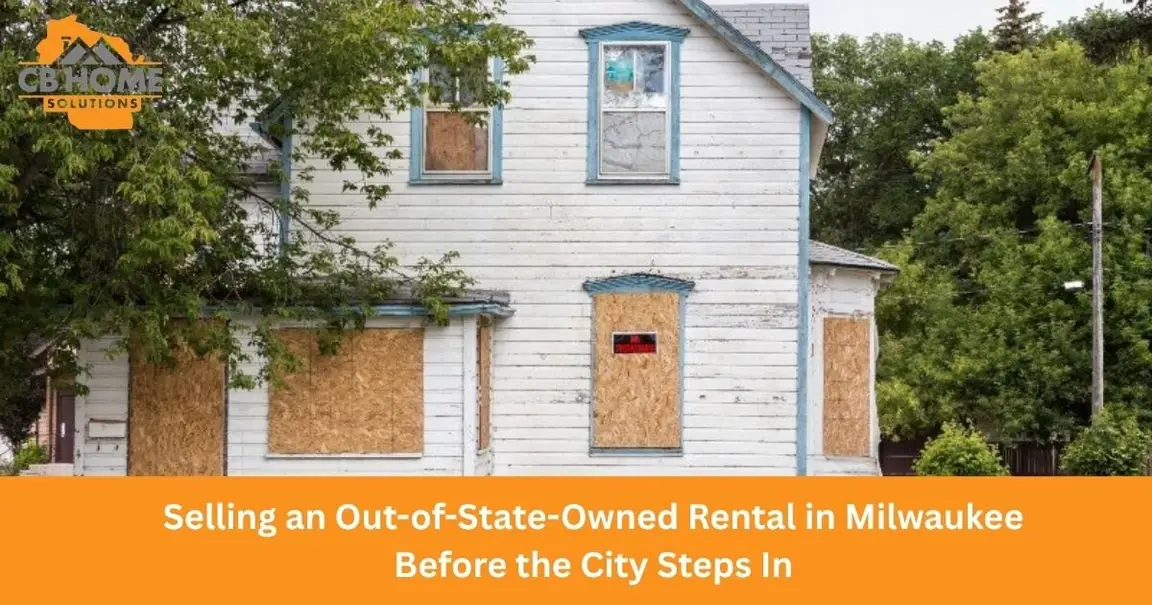
If you own rental property in Milwaukee from another state, the ground has shifted under you over the past year — and if you haven’t been paying close attention, you may not realize how much. The City of Milwaukee has escalated its enforcement against absentee and negligent landlords dramatically, and the tools it’s using can end with the city taking operational control of your properties. If your Milwaukee rentals have deferred maintenance, code violations, or unpaid taxes stacking up, this is the moment to understand your options — including selling before the situation escalates.
I’m Carter Crowley. My dad Bryan and I run CB Home Solutions, and buying from out-of-state Milwaukee landlords is a core part of what we do — including an entire eleven-property portfolio we purchased from one owner managing from a distance. This guide explains the enforcement climate, why out-of-state owners get caught in it, and how selling fast to one buyer can be a clean exit.
The Enforcement Climate Has Changed
For a long time, absentee ownership of Milwaukee rentals was a low-friction business: buy cheap, collect rent, defer maintenance, and the consequences were manageable. That era is ending.
In 2026, the Milwaukee City Attorney’s Office filed some of the largest public-nuisance enforcement actions in the city’s history against a major out-of-state landlord network accused of widespread neglect, code violations, vacancy, and unpaid property taxes across more than two hundred properties. The city asked the court to declare the properties a public nuisance and — critically — to appoint a third-party receiver to take over the properties if the conditions weren’t fixed within a short window. By mid-2026, a judge had ordered dozens of those properties into receivership, largely stripping the owner of control.
The mechanism matters, because it’s what makes this different from the old days of a citation here and there. A receiver steps into the owner’s shoes: as tenants pay rent, that rent is directed toward fixing the conditions and abating the nuisance — not to the owner. In other words, the city found a way to take operational control of neglected rentals and redirect their income to repairs.
This was aimed at the worst large-scale offenders, but the message to every out-of-state Milwaukee landlord is clear: the city is watching, the tools are sharper, and neglect now carries real risk of losing control of your properties.
Why Out-of-State Milwaukee Landlords Get Caught
If you own from a distance, you’re structurally more exposed to this, and it’s usually not because you don’t care — it’s because distance makes management genuinely hard:
Property managers underperform. Many out-of-state owners rely on a management company, and when that company doesn’t do its job — ignoring repairs, mishandling tenants, skipping inspections — the owner often doesn’t find out until violations have piled up. This is one of the most common stories I hear.
Code violations stack up unseen. Milwaukee’s Department of Neighborhood Services (DNS) inspects and re-inspects, and each missed deadline can add reinspection fees. From another state, you may not even see the orders arriving until the charges have accumulated.
City charges become liens. Unaddressed violations lead to the city doing the work — boarding, cutting grass, or more — and billing it back as special-assessment charges on the tax bill. (Our guide on selling a Milwaukee house with city liens or back taxes explains how these accumulate and cloud your title.)
Unpaid taxes compound the risk. Delinquent property taxes on top of code issues are exactly the combination the city’s recent enforcement targeted.
The through-line: distance turns small, fixable problems into large, entangled ones, because no one local is catching them early.
The Cost of Waiting
Every month you wait, the situation gets more expensive and harder to exit:
- Reinspection fees and special-assessment charges keep accumulating on the tax bill.
- Receivership risk grows if violations go unabated — and a receiver redirects your rental income away from you.
- Forced repairs on the city’s timeline are more expensive and more stressful than repairs on your own.
- The property keeps deteriorating, which lowers what you could sell it for.
Waiting is the most expensive option, and for an out-of-state owner it’s also the least controllable, because you’re managing a worsening situation from far away.
Sell the Portfolio Fast to One Buyer
Here’s the alternative that a lot of out-of-state Milwaukee landlords don’t consider until late: instead of fixing everything from a thousand miles away or watching the city take over, sell to a single cash buyer who takes the properties as-is, with tenants in place, in one transaction.
This is exactly what we did with Trevor, an out-of-state owner of eleven Milwaukee-area rental properties — a mix of homes on Sherman Blvd, Rohr Ave, Custer Ave, Lawn Ave, Linwal Ln, and several north-side addresses. His property management company wasn’t performing, and managing eleven buildings from another state had become a second job he never wanted. Rather than fix or sell them one at a time, he sold the entire portfolio to us in a single closing, with tenants in place, as-is. One buyer, one transaction, one clean exit.
We also bought 3613 N 11th St, a north-side rental whose out-of-state owner had been taken advantage of by contractors who left the house gutted mid-renovation. A property in that condition, in that part of Milwaukee, had no realistic path to a financed buyer. A cash sale was the only door actually open, and it let him cut his losses fast.
The advantages for an out-of-state owner:
- One transaction, not many. No coordinating separate listings, showings, and closings across a portfolio.
- As-is, tenants in place. No repairs, no evictions, no bringing anything up to code first. (Our guide on selling a Milwaukee rental with tenants in place covers the tenant-law mechanics of an occupied sale.)
- We take over the city problems. Once we close, the code issues, the tenant management, and the ongoing obligations become ours.
- Remote closing. We handle everything on the ground here; you sign with a mobile notary wherever you are.
The Honest Comparison
As always, the straight version. If your Milwaukee rentals are in decent shape, you have reliable local management, and you’re not facing enforcement pressure, you may do better holding them or selling individually on the open market to capture full value. A cash portfolio sale trades some top-line price for speed, certainty, and the elimination of the whole distance-plus-enforcement problem.
But if the properties have deferred maintenance, accumulating city charges, or you’re feeling the enforcement climate tightening around absentee owners — and especially if managing from afar has become untenable — a fast sale to one buyer is often the smartest exit. It stops the bleeding before the city forces the issue.
The Bottom Line
Milwaukee’s enforcement against absentee and negligent landlords has real teeth now, up to and including receivership that strips owners of control and redirects rental income to repairs. Out-of-state owners are structurally exposed, because distance turns small problems into large, entangled ones. If your Milwaukee rentals are heading that direction, selling as-is to a single cash buyer — with tenants in place, in one transaction, closed remotely — is often the cleanest way out before the situation escalates further.
If you’d like to know what we’d offer for your Milwaukee rental or portfolio, occupied or not, any condition, there’s no cost or obligation to find out. You can learn how we buy rental properties with tenants in place, how we buy houses as-is in any condition, or reach out through our Milwaukee page or call (920) 215-4201.
For related situations, see our guides on selling a Milwaukee rental with tenants in place (the tenant-law side), selling a duplex or triplex in Milwaukee (multi-family valuation), and selling a Milwaukee house with city liens or back taxes (the accumulating-charges problem).
FAQ: Selling an Out-of-State-Owned Rental in Milwaukee
Q: Is Milwaukee really cracking down on out-of-state landlords? Yes. In 2026 the Milwaukee City Attorney’s Office filed some of the largest public-nuisance enforcement actions in the city’s history against a major out-of-state landlord network, over neglect, code violations, vacancy, and unpaid taxes across 200+ properties — and a court ordered dozens of properties into receivership. The enforcement climate for absentee owners has changed significantly.
Q: What is receivership, and why should it worry me? Receivership is when a court appoints a third party to take over management of neglected properties. As tenants pay rent, that money goes toward fixing the conditions and abating the nuisance rather than to the owner. In effect, it strips the owner of control and redirects their rental income. It’s the sharpest tool the city has used against absentee landlords recently.
Q: Can I sell my Milwaukee rental with tenants still in it and code violations open? Yes. We buy occupied Milwaukee rentals as-is, with tenants in place and open code issues, and take over the obligations at closing. You don’t have to evict anyone, make repairs, or resolve violations first. This is often the most realistic exit for a distressed out-of-state-owned rental.
Q: Can I sell multiple properties at once? Yes. We’ve bought entire portfolios in a single transaction — including eleven Milwaukee-area rentals from one out-of-state owner, with tenants in place, as-is. Selling to one buyer avoids coordinating separate listings, showings, and closings across every property, which is especially valuable when you’re managing from a distance.
Q: Why not just fix the properties instead of selling? You can, if you have reliable local management and the properties are in decent shape. But fixing deferred maintenance across a portfolio from another state is expensive and slow, and if the city’s enforcement clock is running, you may not have time. For many out-of-state owners facing accumulating charges, selling as-is is faster and less costly than fixing from afar.
Q: How does a remote sale work if I don’t live in Wisconsin? We handle everything on the ground in Milwaukee — walking the properties, assessing condition — and you sign closing documents with a mobile notary wherever you live. We coordinate title and payoff through a Wisconsin title company. Many of our out-of-state sellers complete the entire sale without traveling to Milwaukee.